
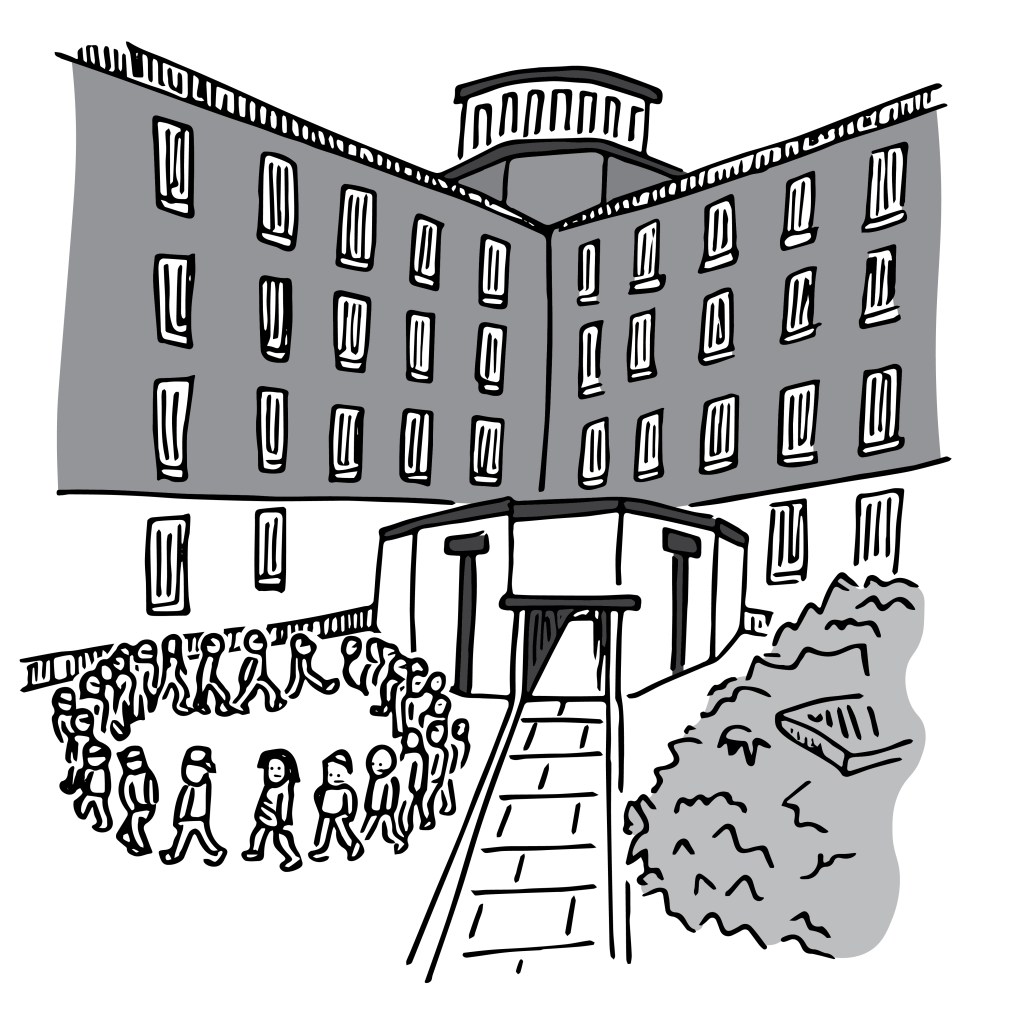
When we think about criminal justice, we tend to identify with the victims. Never could we imagine that we’d end up being the perpetrator. Criminals are other people, not us.
I had been working in the film industry for over ten years when I made the irresponsible and stupid decision to drive whilst being drunk and having used drugs the day before. I feel asleep at the wheel and caused an accident that resulted in a fatality.
There is no excuse, no mitigating factors; I am guilty of having done something terrible. I knew I deserved to be in prison and I sought not to dodge responsibility or be in denial. It’s not murder, but the end result is the same.
In a strange way, as much as I was dreading it, going to prison also felt like a relief. It felt necessary to make amends, draw a line under what happened (as much as that’s ever possible) and reinvent my life.
My goal was to spend my sentence as productively as I could. My coping strategy was to educate myself and learn everything about the prison system and about what distinguished those who managed their sentence well to those who didn’t.
Here are five things that prison has taught me.
1. A strange absence of ‘evil monsters’
There are still some pockets of the press who seem to think that prisoners are some sort of different species of human being; separate from the rest of humanity.
In fact, nothing could be further from the truth. The people in prison are no different from the people outside of it.
Yes, there are people in prison who have done truly horrible things, and there are also some who could be considered ‘evil’, but they form a tiny minority of the prison population.
Most are there because they had a bad start in life, have suffered trauma and abuse, lack education, come from a very deprived background, grew up in gangs, have mental health issues, and have addiction issues.
There are very few prisoners that are truly ‘irredeemable’ – most just need support to tackle their mental health / addiction issues and to obtain the basic education (GCSE’s, learning a trade, studying) that would enable them to find a place in society.
2. Being ‘tough on crime’ is great for criminals
Politicians love being ‘tough on crime’. It’s a vote-winner that always goes down well.
The big problem is that if being ‘tough on crime’ means sending ever more people for longer into prisons that are not fit for purpose, you are actually being very soft on crime.
Overcrowding, understaffing, underfunding and the resulting terrible prison conditions with no meaningful regime for prisoners mean that prisons are rife with drugs and violence, that there is no rehabilitation, and that prisoners reoffend after they leave prison.
Sending more people to prison does not reduce crime. Increasing sentence lengths does not reduce crime.
If we want to reduce crime we need to look at the causes of crime in society: Inequality, unfettered capitalism, the closure of youth centres and community support, inadequate mental health and addiction support in the community, sending people to prison rather than giving them support in the community.
And we need prisons that actually work, and are able to offer rehabilitation.
3. Trying to save means spending a lot more
Nowhere can this false economy be seen as clearly as in the prison system. Austerity saves a bit of money in the short term but then costs a lot more long term. Staff cuts save a little at first, and then end up costing more when all the resulting problems are factored in.
A very basic example in prison is the food. The budget is currently set at £3 per day per prisoner. That is not enough to feed an adult male, which has all kinds of negative side-effects.
Prisoners need to spend their own money on food bought on the prison shop, which means many sell drugs or do other dodgy things to finance the extra cost.
Bad and insufficient nutrition affects the mental health of prisoners who are not able to focus in education or who become aggressive and cause damage.
The bottom line is that by trying to save a few pounds on prison food, the Prison Service is causing a lot of damage and ends up spending a lot more down the line than if it had provided adequate nutrition in the first place.
4. Governments refuse to tackle the core issues that would solve the crisis
The issue is actually quite simple: The UK is sending far too many people to prison and at the same time is not investing enough in its prisons.
The problem isn’t that we haven’t got enough prisons; the problem is that we have too many prisoners and that our prisons aren’t fit for purpose.
We should build more prisons so we can close the ones that should have been closed decades ago and replace them with modern ones. At the same time, we should reduce the prison population, not increase it.
We could do this by ending the addiction to prison as the only criminal justice solution available; and increase out-of- court solutions as well as different types of community sentences. We should rethink sentencing and end sentence length inflation; reduce the use of remand and short sentences.
Most importantly, we should address the causes of crime in society, rather than using prison as diversion to avoid having to discuss them.
5. Like it or not, but punishment doesn’t work.
Prisons that are ‘holiday camps’ do
Punishment doesn’t work. It never has and it never will.
If you want to try to prevent a prisoner from taking Spice, the worst thing you could do is take away his TV and privileges – it will just make him smoke more Spice. One of my cellmates has been to prison over 40 times. And he hated it every single time, which never stopped him from coming back.
He’s the living proof that punishment alone achieves nothing.
Many prisoners have been punished in some form or another throughout their lives. What they need is not punishment; it is help and support.
The deprivation of liberty is the punishment, what happens inside prisons should be rehabilitation.
We might not want to hear it because it goes against our instincts, but the fact is that the ‘holiday camps’ we see in Norway actually work.
The hellholes we see in the US don’t.
 Words without waffle
Leave a comment