

“Time and again, when given an option, people will usually choose hope over hate. It’s just that we need to give them that hope.”
This is the central message of this book: That in many cases, people who end up supporting far- right parties are neither rabid racists, nor hold views as extreme as the leaders of those parties.
It’s simply often that they feel they have no other choice, as they find themselves completely abandoned and let down by the main political parties.
One of the many powerful examples he provides for this is a group of mothers, one of whose daughters has been the victim of Asian grooming gangs in Rotherham.
Being angry and disgusted at the failings of local authorities, police and the local Labour government, they decided to join an EDL (English Defense League) march, although with initial unease.
They walked at a distance from the EDL group, to show they did not want to be too closely associated. But as they were greeted with: “Nazi scum off our streets!” shouts by the anti-fascist counter protesters, they quickened their pace and joined the main EDL group. “If they think we’re nazis, then we might as well act like we are.”
These women were right to be angry as one of their daughters was completely failed by the authorities and the local Labour party. And since nobody else offered any way of protest, the EDL was all there was.
When the progressive left completely ignored the issue of grooming gangs – either out of fear of how they might be perceived, or because it didn’t fit their narrative -, it left a vacuum that the far right was immediately able to fill.
Lowles therefore stresses the importance to have the courage to call out and address hate and violence coming from all sides, even when it might be politically difficult.
PREACHING AND SHOUTING DOESN’T WORK
The other take away of this anecdote is how all the counter protesters achieved by insulting the women was to further entrench already held views. It was them after all who ultimately drove them to join the EDL.
Shouting doesn’t work, nor does preaching to people and judging them, arrogantly telling them what they’re supposed to think or do. If you do this you’ll either be ignored or worse, people will double down on their views. If you’re a vegan and you want to get people to eat less meat, shouting “You evil murderers!” might therefore not be the best strategy, nor will calling Tommy Robinson supporters racists ever serve your cause.
The only way to convince people of something is to literally prove its veracity to them again and again. What’s therefore important is to spend time in an area with people and to honestly listen to them, rather than telling them what to do.
“One of the key lessons we have learnt from the Hope not Hate campaign is that you have to earn the right to be heard….You can earn trust by spending time in an area. Understanding why people are doing what they are doing and thinking what they are thinking. Showing that you genuinely care about their needs and involving them in the decision making. Earning the right to be heard requires humility, empathy and a lot of hard graft.”
What this shows is how difficult a job defeating the far right actually is. How much leg work is required; how much time and work it takes to earn trust in a community.
A TREASURE TROVE OF VALUABLE INFORMATION
How to defeat the far right combines the history of Hope Not Hate, told through the stories of their ground work combined with the statistics and findings of the many reports that the group has published. Put together, one is left with a real sense of understanding our biggest societal issues better and why people are driven towards the far right.
WHY?
The question of why people support the far right is perhaps best answered by looking at the two most decisive factors that make an area most susceptible to far-right support.
1. Highest levels of deprivation
2. Lowest immigrant population
So the areas with highest support for the far right are the ones that have the fewest foreigners but are the most deprived.
This makes sense, of course. If all your friends and neighbours are immigrants, you’ll realise that they’re just like you and not more likely to be murderers and rapists, or benefit scroungers. Equally, if you’re doing ok yourself, you’ll be much more likely to be generous to others.
What’s also interesting about this finding is how reducing immigration would not even affect the lives of far-right voters as they come from areas that have the lowest number of immigrants in the first place.
THE SOLUTIONS
The solutions are therefore shockingly simple. If you want to defeat the far right you need to make people’s lives better. When people are well off and happy, they hate less.
For some reason, the main political parties do not seem to grasp this simple fact. Instead of trying to actually improve people’s lives, all they deal with are optics. Appearing to be ‘tough on immigration’ or appearing to be ‘tough on crime’, all depending on recent focus group findings. All that counts is the optics, the opinion polls and the next election. Little of it is actual substance that will make things better for most people.
Lowles points to the breakdown of community – first due to the collapse of the manufacturing industry, then after austerity following the financial crash of, 2008 has completely gutted local public finances and support networks – as a key factor in reducing people’s quality of life. Community and civic pride are key, and in order to defeat the far right, both need to be restored. He also criticises the Labour government for mostly investing in the already affluent South East, rather than the areas that need it the most.
TWO BAFFLING STATISTICS
Two statistics stood out to me and offer another key insight into what’s going on.
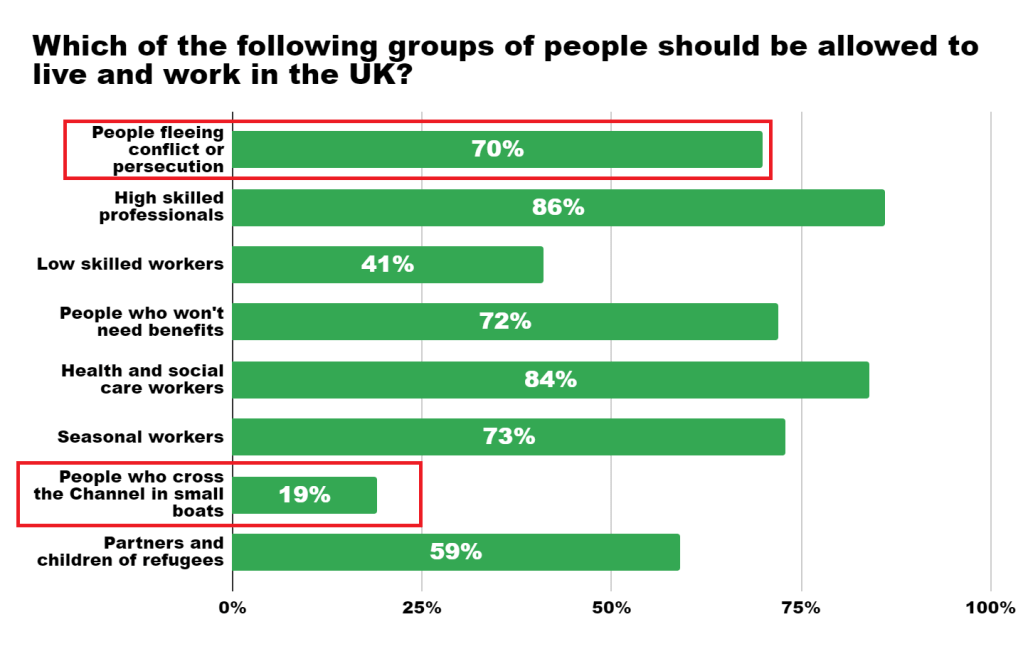
In their 2024 Fear and Hope report, Hope Not Hate asked over 3,000 people about their attitudes towards immigration. 70% said that Britain should allow those fleeing war and prosecution to live and work in the UK. But when asked whether people arriving in small boats should be allowed to live and work here, only 19% agreed.
To me this is utterly baffling and makes no sense whatsoever. How can you be in support of helping those fleeing wars and persecution, but against helping those arriving in small boats when they’re one and the same people? The vast majority of people arriving in small boats are fleeing war and persecution, and there is no other route for them available to claim asylum in the UK.
Another statistic equally baffling regards the environment.
In a poll of over 7,000 people in 2024, more than 75% of reform voters were opposed to net zero policies. However, when asked about the importance of cleaning up our rivers, 82% of them agreed that cleaning up our rivers should be a national priority and only 4% were opposed. This again highlights the absurdity of Reform UK’s position on the environment. How can you be for cleaning up our rivers but against net zero when it is the big polluters responsible for the largest greenhouse gas emissions who are also responsible for polluting our rivers?
This shows how much framing is important and how well propaganda actually works. What these two statistics show is that Reform voters seem to have bought the narrative that people crossing the Channel aren’t genuine asylum seekers but fraudsters and that net zero has nothing to do with protecting the environment.
What this also shows is that we all are actually concerned about helping others and about protecting the environment. We all want more or less the same things, but have bought into different narratives and form our opinions based on completely different sets of factual information.
This creates a stalemate that we’ll not be able to break unless we are able to question our own position and listen to the other side.
More than anything, we need to open up and learn to talk to each other again. And in order to do that, the most important thing is to learn to listen again.
Reading How to Defeat the Far Right should be a great starting point in this process, regardless of which side one is coming from.
The Hope not Hate website also has all the reports of the group, offering much insight.
 Words without waffle
Leave a comment