Silicon Valley’s quest to decide our future
Although we might be afraid of death, most of us understand that the gift of immortality would not be a blessing, but a terrible curse. Because we know that what gives life meaning is the fact that it must come to an end. Time is precious because we only have so much of it.
Equally, few of us would want to live on Mars. Why would you want to live on a barren hellscape when there is so much beauty right here on Earth?
Even more ridiculous and less appealing is the idea of uploading our minds to a supercomputer, merging with the digital cloud and leaving our physical bodies behind. You’d struggle to find more than very few people who’d consider this a future worth living for.
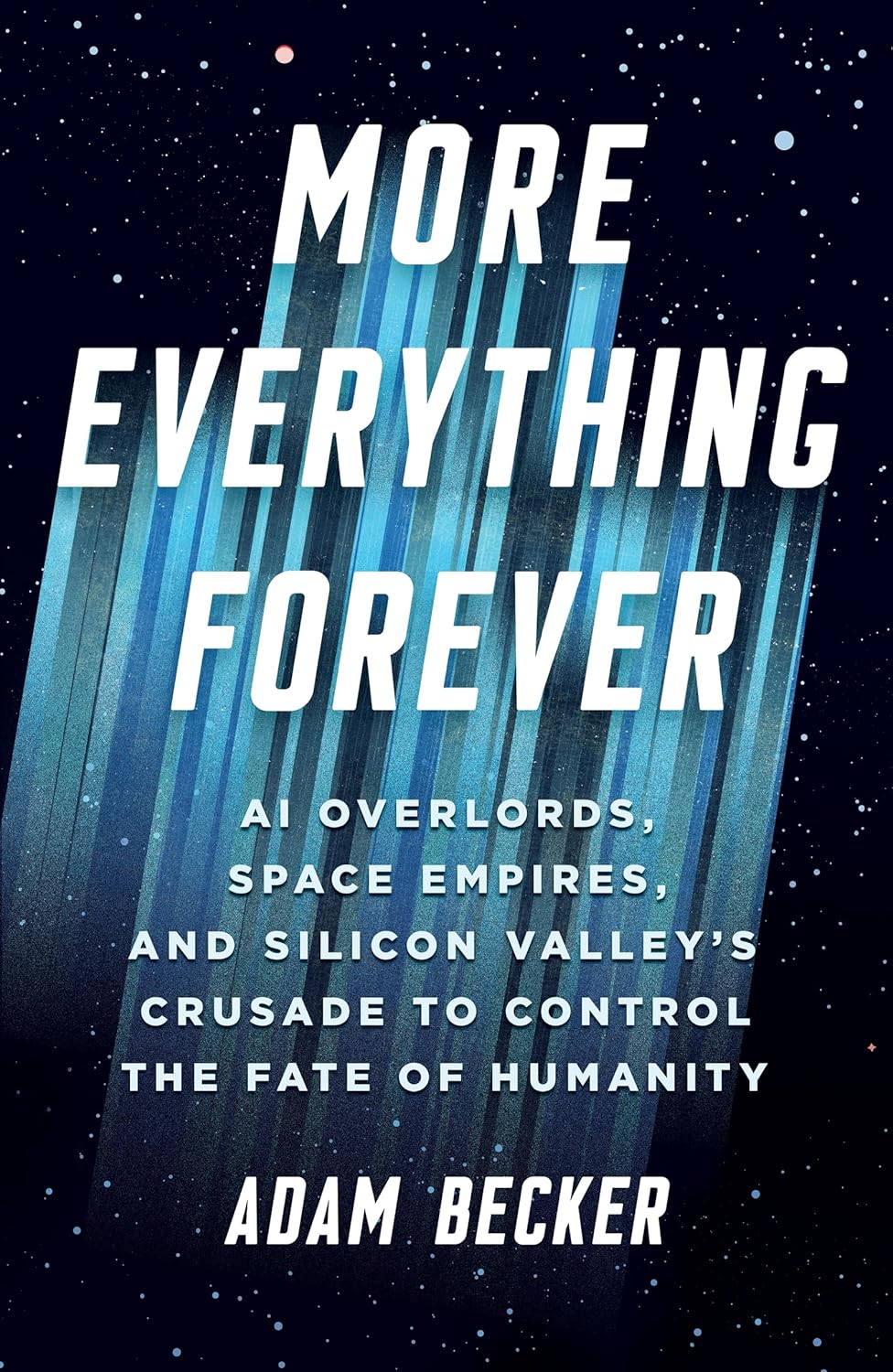
But the people that Adam Becker talks about in his book are not like most people. They are definitely not. With passionate (and I believe, justified) anger, he likes to call them: “These fuckin’ people”.
Apart from being unfathomably rich, the tech bros of Silicon Valley have some very strange ideas. And it is only because of their incredible wealth and the resulting political power that these ideas have entered the mainstream and received unwarranted credibility.
What Becker, who has a PhD in astrophysics, does in this book is to look at these ideas – which form the tech bro ideology (summarised under the acronym TESCREAL) – and take them apart one by one, using science, reason, logic, humanity and common sense.
We find out, for example, that even immediately after a giant asteroid wiped out most life including the dinosaurs, Earth was still an infinitely more hospitable place to live on than Mars will ever be. We survived, after all, whereas absolutely nothing could survive on Mars. Even the worst nuclear war imaginable and worst effects of global warming couldn’t render Earth less inhabitable than Mars.
And even if we could somehow build underground bunkers or giant domes on Mars that would overcome all the issues of mortal radiation, lethal temperature, toxic soil, lack of oxygen, lack of gravity; there are still a million other reasons why colonisation of Mars is simply nothing other than pure science fiction.
We also find out (if we didn’t know it already) that we are much less close to developing artificial super-intelligence than AI marketing wants us to believe.
The fact is that we don’t even have a clear, undisputed definition of what intelligence is. Nor do we know how intelligence and consciousness are created in the brain.
We basically know nothing about how the brain actually does what it does, and how human intelligence and consciousness arise, yet these people claim that they can build something that doesn’t just replicate the brain, but will be infinitely better than it. How can you build a skyscraper if you don’t actually know how to build a shed?
Their assumption is that the brain is basically the same as a giant computer. But this assumption is wrong. Neurons aren’t computer chips and the brain wasn’t designed, but evolved over millions of years.
What follows from their brain- as- computer assumption is that all that is needed to create artificial super-intelligence is ‘upscaling’, i.e. feeding models such as ChatGPT more and more data and giving it more storage and connections.
Again, this assumption is wrong. ChatGPT isn’t intelligent or sentient, nor will it magically become so if you make it bigger. In reality, we’re not much closer to creating a computer that thinks and is aware than we were 50 years ago. There is actually good reason to believe that it might not be possible at all to ever do so.
More than just debunking the ideology of the tech oligarchy, Becker explains what purpose it serves.
Tech billionaires believe what they believe in order to justify and excuse their morally bankrupt behaviour. Rather than being the bad guys who destroy the environment, shamelessly steal intellectual and artistic property, exploit workers, lie about their true intentions in order to make themselves incredibly rich at the expense of everyone else, they are actually the saviours of mankind. All this destruction and misery will be so worth it, once they’ll have developed the technology that will magically solve all of the world’s problems at once.
It is therefore that Becker calls their belief system ‘the ideology of technological salvation’. Technology will eventually solve everything.
Any damage caused along the way is small fry and unfortunate but necessary collateral damage.
Apart from being psychopathic, this ideology also ignores reality. Many of our problems are social problems that no amount of technology will ever be able to solve. Technology will not solve global warming because it requires large-scale behavioural change. It requires that we consume less, not built more data centres.
Structural wealth and racial inequality can never be solved with technology (in fact current AI systems with built-in biases are making it worse) but by changing our economic and political systems.
Our resources are limited and the only reason these people can be as rich as they are, is because millions of others are starving to death.
Unlimited growth is unsustainable because it goes against reality. It is simply impossible.
Everything must come to an end. Our lives, the life on Earth and eventually even the Universe will implode. Ultra-capitalism is taking and destroying something it doesn’t own, living on borrowed money and borrowed time.
But of course the tech oligarchy doesn’t accept these realities, not just because it would threaten their profits, but also because it would require them to take a good hard look in the mirror.
Jeff Bezos is quoted in the book as saying that the greatest fear he has for his children is a future of stagnation. Of a limit to growth that might require rationing. That is his greatest fear for his children.
It’s unclear whether to be furious that such a psychopath could have so much power, or feel sad for him because he is obviously a very damaged person who is missing something very essential and human.
And this is a conclusion that I draw from reading Becker’s book and thinking how much influence these few people have over all of us.
That what makes them so different is that they are very damaged people who misunderstand the basics of what makes life worthwhile and meaningful.
Sci-fi literature is a good example. These guys all grew up devouring sci-fi literature. But they completely misunderstand its message.
Sci-fi stories aren’t blueprints for the future, but cautionary tales. Warning us where the future might take us if we aren’t careful. They’re mirrors, showing us where giving in to temptation and the worse angels of our nature might lead to.
Becker cites Peter Thiel as saying (I paraphrase): “I prefer Star Wars to Star Trek because it’s about capitalism. Star Trek is the communist show.”
Anyone who has watches Star Wars knows it isn’t about capitalism at all. George Lucas was a leftie when he wrote Star Wars and his model for his evil empire were the United States. His rebels were the Viet Cong.
Nor is Star Trek about communism. It is about societal and personal progress and maturity. Patrick Stewart – conscious of being bald in a leading role – asked Gene Roddenberry whether in the 24th century they wouldn’t have found a cure against baldness. Roddenberry’s answer was that in the 24th century nobody would care if you were bald or not.
Vanilla Sky: Example of a sci-fi morality tale

In the cheesily written and directed but underrated 2001 film, billionaire David Aames is cryogenically frozen after a terrible accident that disfigures him. He lives the ‘lucid dream’, a simulation of life where everything is perfect.
After a glitch in the program, he is confronted with the reality that he has been dead for hundreds of years and that his life is not real but a fantasy.
He has the choice of returning to this wonderful dream state with his love Sofia, or returning to the harsh reality of real life. Eventually, he decides that he wants to live a real life, showing that he has matured as a person.
We identify with him, because as much as we’d sometimes wish we could have everything we want, deep down we know that the sweet is only sweet because of the sour, and that only a life full of difficulties and sometimes pain is worth living.
The tragedy
The tragedy of all of this is that these people have so much money and power; they are the very few who could actually solve our problems and make everyone’s life better. Oxfam estimate that increase of billionaire wealth in one year alone (2025) would be enough to end world hunger.
But instead, they do the opposite. They make life considerably worse for everyone, burning trillions of dollars and our planet and future for futile and dumb vanity projects in order to boost their megalomaniacal messiah complex.
The fundamental problem at the core of our ills
But rather than looking only at individuals, Becker concludes that the fundamental problem is that we as society allow the existence of billionaires and such grotesque concentration of money and power in the hands of a few in the first place.
He quotes Louis Brandeis as saying over eighty years ago: “We may have democracy, or we may have wealth concentrated in the hands of a few, but we can’t have both.”
It’s easier to imagine the end of the world than the end of capitalism. But as the sci-fi author Ursula K. Le Guin reminds us: “Any human power can be resisted and changed by human beings.”
And that is Becker’s conclusion, that as much as the Tech bros try to convince us that their vision of the future is inevitable and already written, in reality it isn’t. We have the power to fight back and determine our own future. The future is open.
Or, as David Aames was reminded in Vanilla Sky: “Every passing moment is a chance to turn it all around.”
MORE EVERYTHING FOREVER is an excellent, important book and essential reading for anyone who cares about our future and wants to understand how those who are already determining it for us think.
 Words without waffle
Leave a comment